
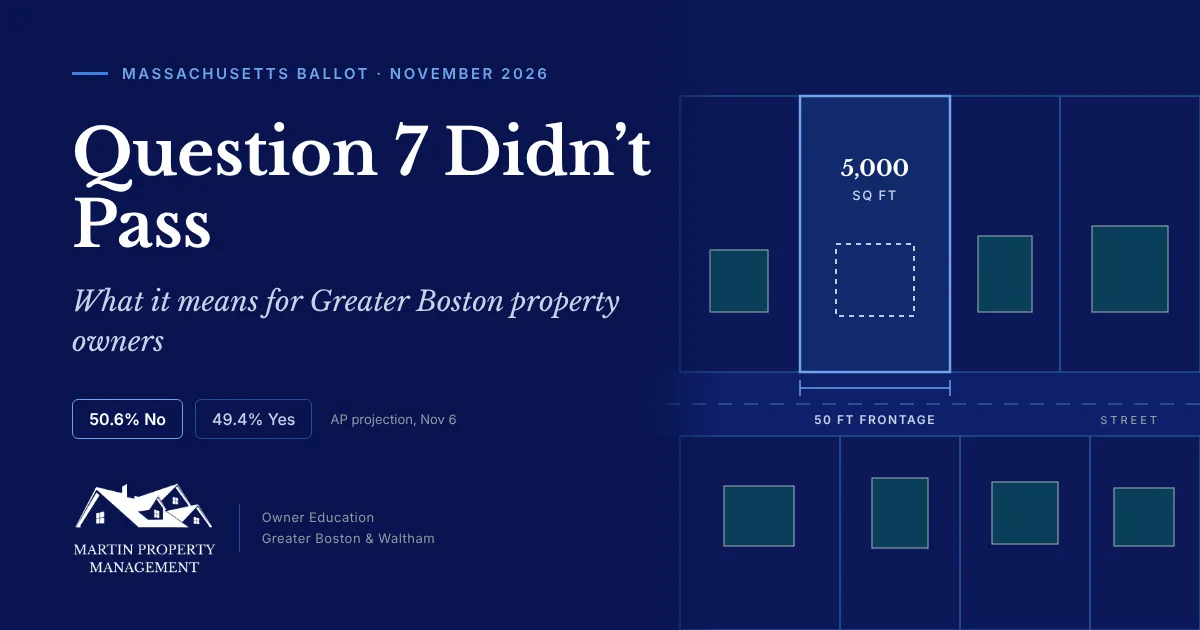
It took three days to call. Question 7, the statewide ballot measure on minimum lot sizes for single-family homes, was the closest race on this year's Massachusetts ballot. The Associated Press projected on Friday afternoon, with 99% of votes counted, that it was rejected 50.6% to 49.4%, a difference of 32,322 votes out of more than 2.5 million cast.
For property owners, the practical answer is simple: nothing changes in how lot sizes are regulated. But the question touched on something that affects every owner and investor in Greater Boston, which is how zoning shapes what can be built, and at what cost. Here's what Question 7 would have done, why it drew so much attention, and what it means for you now.
What Question 7 would have done
Today, each city and town in Massachusetts sets its own minimum lot size for building a single-family home. In many suburbs that minimum is large, often 20,000 or 40,000 square feet, and in some places more.
Question 7 would have created one statewide standard. A single-family home could have been built on any residentially zoned lot of at least 5,000 square feet, with at least 50 feet of frontage on a street and access to public water and sewer. Communities would still have regulated things like height, setbacks and parking. The City of Boston was not covered, because it has its own zoning law, and neither were rural areas without public water and sewer.
Why lot size affects what gets built
This was the heart of the debate, and it comes down to simple math.
Land is one of the biggest costs of building a home. When zoning requires a large lot for every house, the full cost of that land has to be recovered by a single home. For a builder, that often means the only project that makes financial sense is a larger, more expensive house, rather than several smaller ones that the zoning doesn't allow. Supporters of Question 7 argued that this is one reason new single-family homes in many suburbs are so expensive, and why smaller "starter homes" are rarely built.
Opponents saw it differently. They argued that a single statewide rule ignores local differences in infrastructure, schools, roads and environmental conditions. They also pointed out that the measure didn't require smaller or more affordable homes; a builder could still put a large, expensive house on a 5,000-square-foot lot. For them, these decisions belong with local planning boards that know their communities.
Both sides agree on the underlying fact: housing costs reflect many factors at once, including land, zoning, construction costs, interest rates and taxes. That's why the vote was so close.
Where Greater Boston voted
The results showed a clear geographic pattern. Support was strongest in places already used to smaller lots, including Boston, Cambridge and Newton, while many communities across Central, Eastern and Southeastern Massachusetts voted strongly against it. Even though Boston itself was exempt, its voters overwhelmingly supported smaller lot sizes.
What it means for owners now
Local rules stay in place. If you own a larger lot and were wondering whether you could split it, the answer depends on your city or town's zoning, just as before. Some communities already allow smaller lots; others don't.
Local zoning can still change. The vote doesn't stop cities and towns from revisiting their own lot-size rules. Given how close the result was, expect the conversation to continue at local planning boards and town meetings.
Other options may already be available. Depending on your property, there may be other ways to add value or housing that don't depend on lot size, such as an accessory dwelling unit (ADU). Massachusetts now allows smaller ADUs by right in single-family zoning districts, subject to local requirements.
What owners should do
- Know your lot. Check your property's zoning district, lot size and frontage with your city or town.
- Don't act on headlines. Before planning a subdivision or addition, talk to a land-use attorney, surveyor or your local building department.
- Watch your local boards. Zoning changes now happen town by town. Planning board agendas are public.
- Think long-term. Zoning shapes supply, and supply shapes rents and values. Understanding local rules is part of smart portfolio planning.
Bottom line
Question 7 didn't pass, so lot-size rules in Massachusetts stay local. But the near-even split shows how much attention housing supply is getting, and the discussion isn't over. For owners, the best move is to understand the rules that apply to your property today and stay informed about what your community decides next.
Want to talk through the strategy for your property?
Book a free consultation:
https://calendly.com/scott-martinhomemanagement/real-estate-investors-pm-services
Or call: 617.957.0166